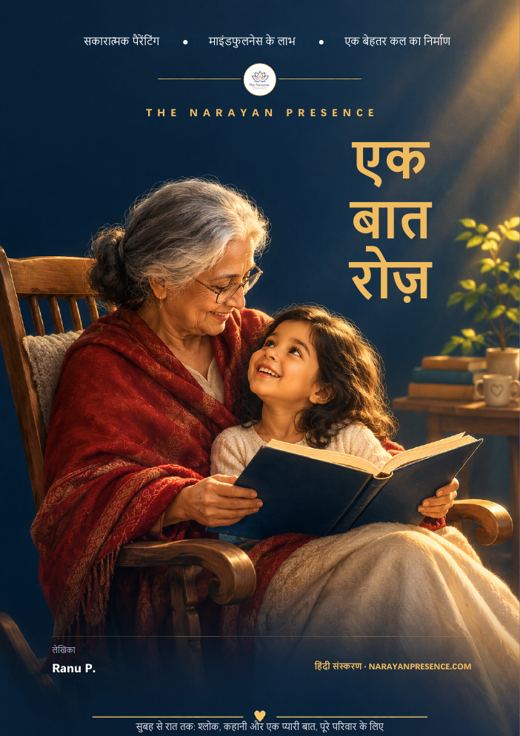
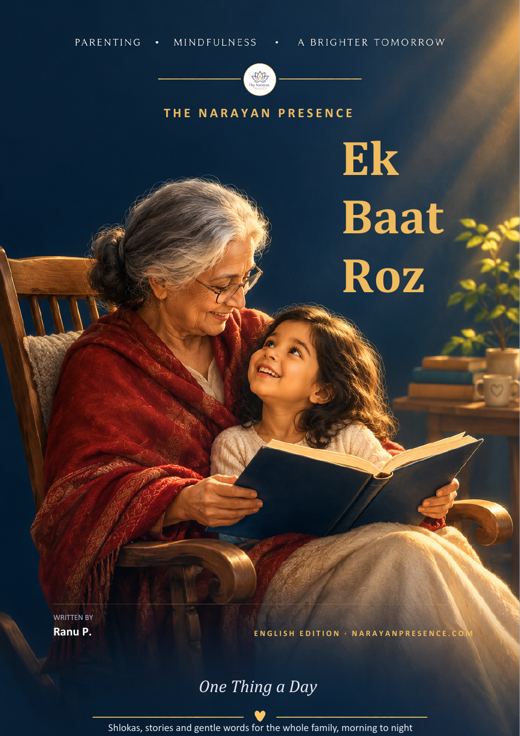
Ek Baat Roz turns nine everyday moments, from waking to sleep, into 20-second pauses your whole family does together. A shloka, the story behind it, and one simple line for everyone from your 3-year-old to Dadi.
The habits children keep for life are built on ordinary mornings, not in festival weeks. Move the slider to your youngest child's age.
mornings left before they turn 18. 12 years of chances to start the day with a thank-you instead of a notification.
Mornings begin on a phone. Meals happen in front of a screen. A reel plays until sleep. Nobody is to blame. Life just got fast, and the small things Dadi did without thinking slipped quietly out of the house.
We'll teach them later.Later never comes.
why?and you don't have an answer.

"Every morning, my grandmother sat up in bed and looked at her palms. I thought she was searching for something. Years later I understood. She was beginning her day with a thank you. This book is for every home that wants that back."
The Joshis live through every page of the book. Tap to see how their day changes.
Pooja's hand reaches for the phone before her eyes open. 14 messages and an "Urgent!!". Tired before the day begins.
Phone charging in another room. Palms open like a book, one shloka, twenty seconds. The day starts with her own strength.
Pihu grips the bathroom door and cries. Pooja's voice rises. Like every day.
"Which river is coming into your bucket today?" Bath time becomes a game of seven rivers, and the tears stop.
Three hours, one page, a phone inside the maths notebook. A shout, a slammed door, nothing solved.
Phones in another room. Nikhil sits beside Aarav, not over him. Both fold their hands for one breath. Homework done in 40 minutes.
Cricket on TV, earphones in. One sentence all meal: "A little less salt."
Screens off, the thank-you round. Pihu thanks Dadi "because she's Dadi". Aarav says "pass", and that's allowed too.
Everyone falls asleep on their own screen, carrying the day's small hurts to bed.
The night-time sorry. "I ate Bhaiya's chocolate. Sorry." "I forgive Pihu. Next time, half for me."
Scenes and outcomes from the book's stories.
In Dadi's time this mala strung itself. Today we string it on purpose. You don't start all nine. Pick one, and the book shows you when to add the next.
Keep it in the kitchen, on the study table, beside the bed. Open any page and you know exactly what to do today.
Nine moments, each with its shloka, Dadi's story, a "Pihu asks" answer, three small steps and one promise.
Their stories and how to chant them, from 3 times before sleep to 108 with a mala.
Four themed weeks. Every day has a short story, a line for each of five ages and a "Say it in Hindi too" line.
The thank-you round, the night-time sorry and the Sunday line, with step-by-step scripts.
When a child refuses, when they ask "why?", when Dadi isn't nearby, and your first seven days.
Word-by-word meanings, and a QR for each shloka at slow and normal speed.
Mantra cards, fridge chart, 30-day tracker, bedtime card, thank-you slips and Seven Rivers. Print as often as you like.
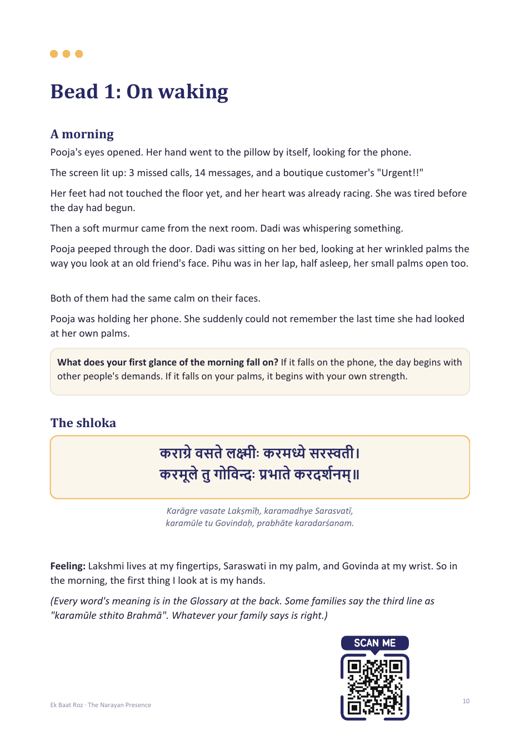
Lakshmi lives at my fingertips, Saraswati in my palm, and Govinda at my wrist. So in the morning, the first thing I look at is my hands.
"Dadi, how does God live in my hand? God isn't that small!"
"God doesn't sit in your hand, bittu. But when your hands do something good, like making a drawing for someone or helping a friend who fell, God's work is happening. So in the morning, we say namaste to those hands."
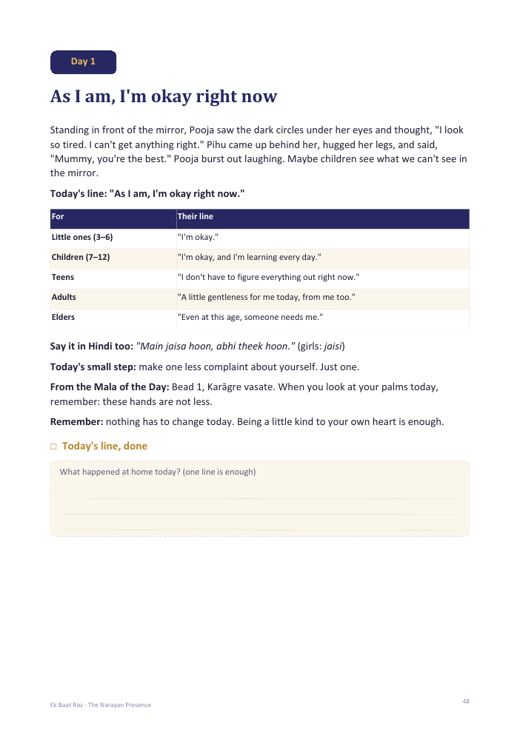
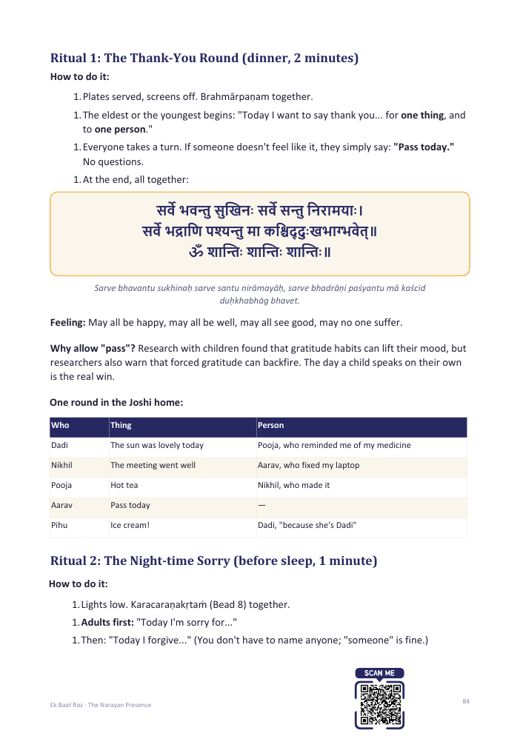
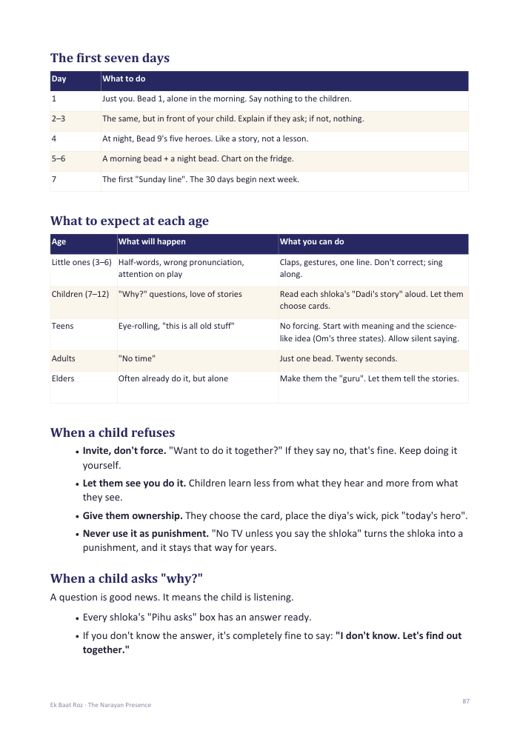
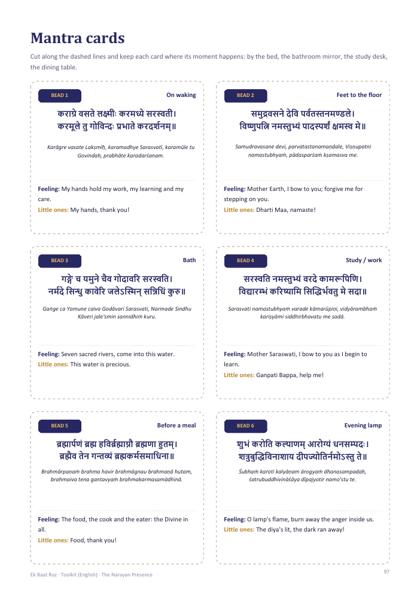
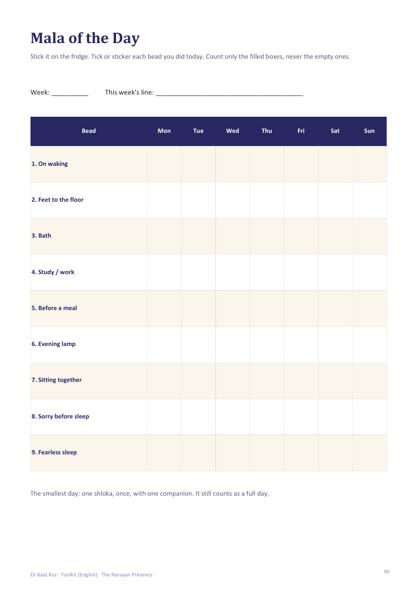
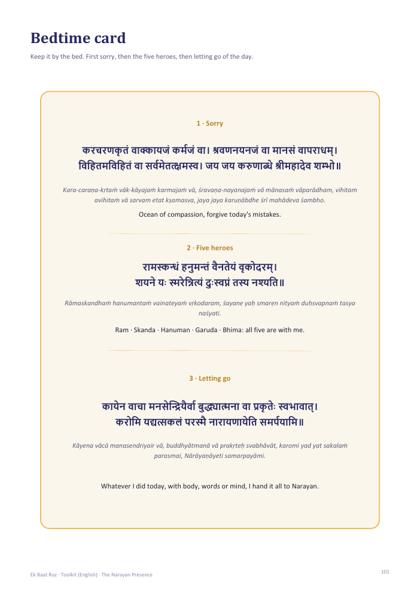
Children follow what they can see and tick. Print these at home and stick them where each moment happens.
Om, three times before sleep, five nights out of seven. It only teaches you to pause.
One thank-you each at dinner. "Pass" is allowed, because forced gratitude backfires.
The night-time sorry, adults first. Children learn sorry by watching.
Remind one family member of one strength every day. Be each other's Jambavan.
Everyone names one thank-you. The day a child speaks on their own is the real win.
Adults first: "Today I'm sorry for..." Then: "Today I forgive..."
Count the ticks, never the empty boxes. Pick next week's line together.
mothers across 14 countries, India included. Young children with a regular bedtime routine fell asleep faster and woke less, and more nights a week meant better sleep.
Mindell et al., Sleep (2015), cited in the book's For Parents section. Every night matters more than one perfect night.Real messages, shared with permission. Numbers and profile photos hidden.
Tap a message to read it in full.
Every edition has every shloka in Devanagari and simple Roman letters, plus the full Printable Toolkit.
After 31 December the price goes up: ₹499 per individual book and ₹799 for the combo. Buy now at the launch price.
For homes where Hindi is spoken at the table, and for Dadi-Nani to read aloud.
Dadi reads Hindi, the kids read English, and everyone says the same shloka together.
For English-medium kids, teens who call shlokas "old stuff", and NRI homes.
Digital product: no refunds for change of mind. Charged twice, or the file won't open? Write to thenarayanpresence@gmail.com and we'll fix it or refund you.
Every shloka has an audio QR code at slow and normal speed. As the book says, a shloka said with love is not less than a shloka said perfectly.
Every page has a plain-words path. Skip the shlokas and use each moment's simple line, like "Today these hands will make something good." Or mix: adults say the shloka, little ones say the simple line.
So does Aarav, the 14-year-old in the book. Each moment has a teen version, like saying it silently in the exam hall. Part 5 explains what to do when a child refuses: invite, don't force.
Every shloka is printed in Devanagari and simple Roman letters, and each day has a "Say it in Hindi too" line. The combo gives you both editions side by side.
Each moment takes 20 seconds to 2 minutes. All nine together are about six minutes. You start with just one.
The language your family reads most comfortably. Both editions have the same content. If grandparents read Hindi and children read English, the combo is ₹499 for both.
The PDF is for the private use of the purchasing family. Please ask them to get their own copy. You can print the Toolkit as often as you like for your own home.
No. It is for peace of mind and good habits at home. It is not a treatment for any illness and does not promise any result. If someone has been struggling for a long time, please speak to a doctor.
One moment tomorrow. A habit your children carry into homes of their own.